

Running a business in the UAE has become increasingly regulated as the country’s tax framework continues to evolve. One of the most significant changes for businesses in recent years has been the introduction of Corporate Tax. While the UAE remains one of the world’s most attractive business destinations, understanding corporate tax obligations is now essential for business owners, entrepreneurs, startups, and investors.
If you’re new to the concept of corporate taxation or unsure how it affects your business, this beginner-friendly guide will explain everything you need to know about UAE Corporate Tax in 2026.
- Introduction
- What is UAE Corporate Tax?
- Why Was Corporate Tax Introduced in the UAE?
- Who Needs to Pay Corporate Tax in the UAE?
- UAE Corporate Tax Rates Explained
- Businesses Exempt from Corporate Tax
- Corporate Tax Registration Process
- Documents Required for Corporate Tax Registration
- Corporate Tax Filing Requirements
- Key Corporate Tax Deadlines
- Common Corporate Tax Mistakes to Avoid
- Corporate Tax Penalties in the UAE
- Benefits of Corporate Tax Compliance
- Why Hire a Corporate Tax Consultant?
- Why Choose SK Tax Agency?
- Frequently Asked Questions (FAQs)
- Conclusion
Introduction
UAE Corporate Tax is a direct tax imposed on the net profits of businesses operating within the UAE. Introduced to align the UAE with international tax standards and enhance transparency, corporate tax has become an important compliance requirement for many businesses.
This guide explains corporate tax in simple terms, covering tax rates, registration requirements, exemptions, filing obligations, penalties, and practical tips to help businesses remain compliant in 2026.
What is UAE Corporate Tax?
UAE Corporate Tax is a federal tax imposed on the taxable profits of businesses operating in the UAE. The tax applies to most business activities, whether conducted by mainland companies, certain free zone entities, or foreign companies with taxable UAE income.
Corporate tax is calculated based on a company’s net profit as reported in its financial statements, subject to specific tax adjustments under UAE tax laws.

Why Was Corporate Tax Introduced in the UAE?
The introduction of Corporate Tax in the UAE aims to strengthen the country’s position as a globally recognized business hub while complying with international tax standards.
The primary objectives include:
- Enhancing tax transparency
- Supporting sustainable economic growth
- Meeting global tax compliance requirements
- Preventing harmful tax practices
- Strengthening the UAE’s international reputation
Despite the introduction of corporate tax, the UAE remains one of the most competitive business environments globally due to its relatively low tax rates.
Who Needs to Pay Corporate Tax in the UAE?
Corporate Tax liability in the UAE depends on the type of business, legal structure, and level of taxable income.
The following entities are generally subject to corporate tax:
UAE Mainland Companies
Businesses operating under mainland licenses are generally subject to corporate tax.
Free Zone Businesses
Qualifying Free Zone Persons may continue to enjoy certain tax benefits if they meet the required conditions.
Foreign Companies
Foreign businesses with a permanent establishment or taxable presence in the UAE may be subject to corporate tax.
Sole Establishments and Individuals
Individuals conducting business activities may become subject to corporate tax if their annual business income exceeds the applicable threshold.
UAE Corporate Tax Rates Explained

UAE Corporate Tax rates are designed to support small businesses while ensuring larger profitable companies contribute to the economy.
- Businesses with taxable profits up to AED 375,000 are taxed at 0%.
- Businesses with taxable profits above AED 375,000 are generally taxed at 9%.
This structure helps support startups and SMEs while maintaining one of the lowest corporate tax rates globally.
Businesses Exempt from Corporate Tax
Corporate Tax exemptions in the UAE apply to specific categories of entities and activities.
Examples may include:
- Government entities
- Government-controlled entities
- Certain public benefit organizations
- Qualifying investment funds
- Certain pension and social security funds
Eligibility for exemptions depends on meeting the conditions specified by the Federal Tax Authority (FTA).
Corporate Tax Registration Process
Corporate Tax registration in the UAE is mandatory for businesses subject to corporate tax requirements.
Step 1: Create an EmaraTax Account
Access the FTA’s EmaraTax portal and create an account.
Step 2: Select Corporate Tax Registration
Choose the corporate tax registration service.
Step 3: Enter Business Information
Provide details including:
- Trade license information
- Business activities
- Ownership details
- Contact information
Step 4: Upload Supporting Documents
Submit all required documents.
Step 5: Review and Submit
Verify the information before final submission.
Step 6: Receive Tax Registration Number
Upon approval, the FTA issues a Corporate Tax Registration Number.
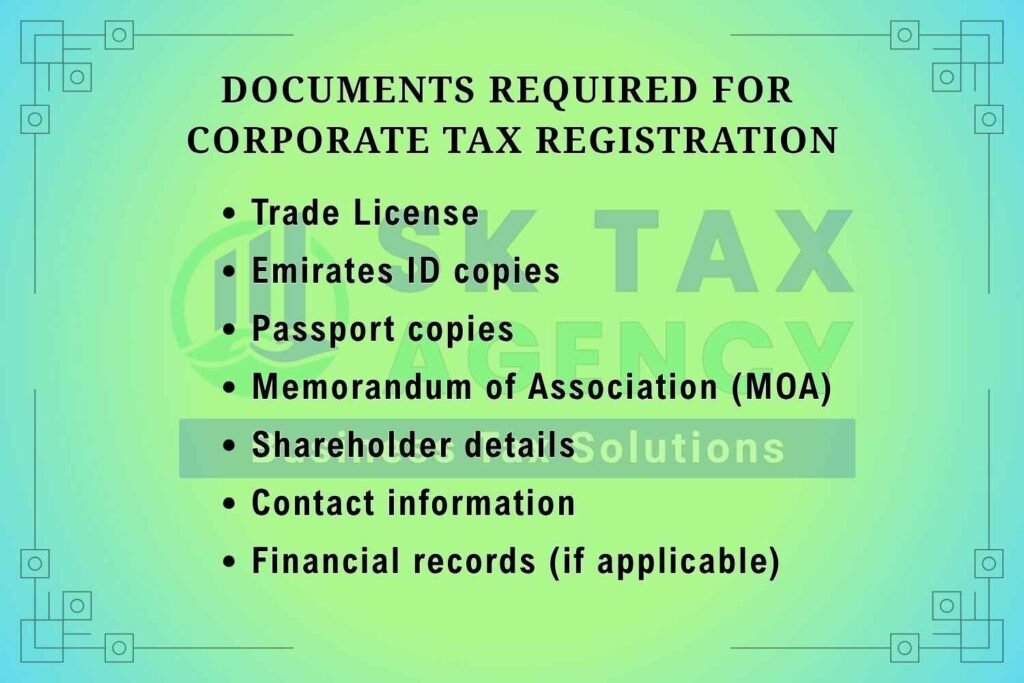
Documents Required for Corporate Tax Registration
Documents required for Corporate Tax registration help the FTA verify the legitimacy and ownership of your business.
Commonly required documents include:
- Trade License
- Emirates ID copies
- Passport copies
- Memorandum of Association (MOA)
- Shareholder details
- Contact information
- Financial records (if applicable)
Corporate Tax Filing Requirements
Corporate Tax filing requirements in the UAE require businesses to submit annual tax returns and maintain accurate financial records.
Businesses must:
- Prepare financial statements
- Calculate taxable income
- Submit tax returns
- Pay tax liabilities before deadlines
- Retain records for required periods
Proper bookkeeping is critical for accurate tax reporting.
Key Corporate Tax Deadlines
Corporate Tax deadlines in the UAE must be monitored carefully to avoid penalties.
Businesses should:
- Complete registration within prescribed timelines
- File annual tax returns
- Pay corporate tax liabilities on time
- Maintain updated accounting records
Working with a tax advisor can help ensure all deadlines are met.
Common Corporate Tax Mistakes to Avoid
Common Corporate Tax mistakes can lead to compliance issues and financial penalties.
Businesses should avoid:
- Late registration
- Poor bookkeeping practices
- Incorrect tax calculations
- Missing filing deadlines
- Failure to maintain supporting documentation
- Misunderstanding free zone tax benefits

Corporate Tax Penalties in the UAE
Corporate Tax penalties in the UAE can apply when businesses fail to meet registration, filing, or payment obligations.
Potential penalties may arise from:
- Late registration
- Failure to file returns
- Inaccurate tax reporting
- Late payment of tax liabilities
- Failure to maintain records
The FTA periodically updates administrative penalties, making compliance essential.
Benefits of Corporate Tax Compliance

Corporate Tax compliance benefits extend beyond avoiding penalties.
Advantages include:
- Stronger financial management
- Improved investor confidence
- Reduced audit risks
- Better business planning
- Enhanced corporate reputation
- Compliance with international standards
Why Hire a Corporate Tax Consultant?
Hiring a Corporate Tax consultant in the UAE can simplify complex tax obligations and reduce compliance risks.
Professional consultants can assist with:
- Tax registration
- Tax planning
- Return preparation
- Compliance reviews
- Tax advisory services
- FTA correspondence
Expert guidance helps businesses focus on growth while ensuring tax compliance.
Why Choose SK Tax Agency?
SK Tax Agency Corporate Tax services provide businesses with expert guidance throughout every stage of the tax compliance process.
Our services include:
- Corporate Tax registration
- Tax assessment and planning
- Compliance reviews
- Tax return preparation
- Accounting and bookkeeping support
- Audit assistance
Our experienced professionals help businesses navigate UAE tax regulations confidently and efficiently.

Frequently Asked Questions (FAQs)
A1: Businesses generally pay 0% on taxable profits up to AED 375,000 and 9% on profits exceeding that amount.
A2: Yes, businesses meeting the applicable criteria must register and comply with corporate tax regulations.
A3: Qualifying Free Zone Persons may benefit from specific tax incentives if they meet eligibility conditions.
A4: Generally, businesses file one corporate tax return per tax period.
A5: Businesses should maintain accounting records, invoices, contracts, financial statements, and supporting documentation.
A6: Yes, businesses with taxable income up to AED 375,000 may qualify for the 0% rate.
A7: Failure to register on time may result in administrative penalties imposed by the FTA.
A8: Freelancers conducting business activities may be subject to corporate tax depending on their annual revenue and business structure.
Final Thoughts
UAE Corporate Tax has become an essential part of doing business in the Emirates, and understanding its requirements is crucial for maintaining compliance and avoiding unnecessary penalties. While the tax system is designed to remain business-friendly, companies must take proactive steps to register, maintain proper records, and meet filing obligations.
Whether you are a startup, SME, free zone company, or established enterprise, staying informed about corporate tax regulations can help protect your business and support long-term growth. With professional guidance and proper planning, corporate tax compliance can become a straightforward part of your business operations rather than a challenge.
If you need assistance with Corporate Tax registration, compliance, filing, or tax planning, the experts at SK Tax Agency are ready to help you navigate the UAE tax landscape with confidence.
Get Expert Help Today
Need assistance in Corporate Tax UAE?
👉 Contact SK Tax Agency for professional Corporate Tax consultancy and ensure your business stays fully compliant.
SK Tax Agency – Business Tax Solutions
📲 Mobile/WhatsApp: +971 50 476 7778
📧 Email: Info@SKTaxAgency.com
🌐 Website: https://www.SKTaxAgency.com
📍 Office Dubai: Al Quoz 3, Dubai, UAE
📍 Office Sharjah: Plot No 4202, Emirates Industrial City, Sharjah, UAE
Connect With Us:
@SKTaxAgencyOfficial